Plan the Work (Block 2)
The design says what the solution is; ten minutes now decide the order it gets built in. This is the cheapest block of the day, and the one place ordering mistakes surface before anything is built instead of halfway through an afternoon.
The prompt
# Plan

You have a design that says what the solution is. Turn it into the order things get built in.

Use **`uipath-planner`** again and derive the implementation task list from `sdd.md` into `tasks.md`, which says what gets built, in what order, by which skill, and where you stop to check. Store it at the folder's root; it is consumed during the build.

- Anything referenced by name has to exist and be published first: models, workflows, processes used as tools, the claim entity, the solution the case and the Agents are scaffolded inside, the standalone Action App deployed into the seat folder. Nothing binds to something unbuilt.
- Action App's *contract* (`contracts/review-task.md`): the case binds it, so it is registered before the case, and the screens come after a run.
- Routing, not redescription. Each task names which skill builds it and which `sdd.md` sections to read.
- Tasks document does not re-explain the architecture; that drifts, and then two documents disagree.
- The case is one task: *build the case from `sdd.md` — resolve, convert, close what convert leaves unresolved*. Its stages, tasks and conditions are not listed here; `sdd.md` is the case's plan.
- A `Validate:` step on every task that generates something, and a testing task before anything deploys.
- Each later block sets the `Status:` line of the tasks it finishes, not only the sub-items — the status line is what a reader scans.

**Done when:**
- someone could work the list top to bottom without opening the design to find out what comes next
- nothing in it is blocked by something further down.
Steps:
- Load the uipath-planner skill
- Derive
tasks.mdfromsdd.mdat the seed root - Keep the case as one task: build it from
sdd.md(resolve, convert, close what convert leaves); its stages are not listed here - Order the tasks leaves-first: entity, agents, app registration all before the case
- Put a
Validate:step on every generating task and a test task before every deploy - Review top-to-bottom: nothing blocked by something further down
- Update
PROGRESS.md
What a good plan looks like
- Leaves before consumers. Nothing binds to something unbuilt: the Data Fabric Claim Record before anything writes to it, the seven Agents before the Case Plan that calls them. The least obvious leaf is the review app's contract: the case binds it, so the app is registered (empty page and all) before the case exists, and its screens come last of all, after real runs have produced real data. You'll see why when you get there.
- Routing, not re-description. Each task names which skill builds it and which
sdd.mdsections to read, and nothing more. A task that re-explains the architecture is a second copy of the design; two copies of one fact always end up disagreeing. - A check after every creation. Every generating task carries a
Validate:step, and a test task sits before anything deploys. The plan carries the discipline the build will be too busy for.
Review the plan
Read it top to bottom once and ask two questions:
- Could someone work this list without opening the design to find out what comes next?
- Does every dependency point up the list? One "blocked by" pointing down means the order is wrong, and it is far cheaper to move a line now than to discover it mid-build.
One more habit this file carries: each later block sets the Status: line of the tasks it finishes. By the end of the day, a reader scanning the status lines sees exactly what was built and what was consciously skipped.
Proof
Evidence from a real run of this block: 33 tasks, every one carrying a Validate: line, and no dependency pointing down the list. The first ten:
tasks.md: the first ten tasks (expand)
Task T1 — uipath-ixp — Adopt the shared IXP project and capture two live extraction payloads
   blocked-by: none
   Validate: both payloads carry every field group with the damage rows repeating per item…

Task T2 — uipath-ixp — Confirm every extraction key the design binds
   blocked-by: T1
   Validate: `check_extraction_keys.py` reports every design path resolved…

Task T3 — uipath-platform — Create the claim entity ClaimCase_<seat> in the seat folder
   blocked-by: none
   Validate: the read-back schema matches `sdd.md` *Case Entity* on all 36 columns and their types

Task T4 — uipath-platform — Prove the claim record round-trips, then delete the probe row
   blocked-by: T3
   Validate: all four values read back unchanged and the probe row is gone

Task T5 — uipath-solution — Initialise the solution before the first project
   blocked-by: none
   Validate: `uip solution restore` succeeds against the empty solution

Task T6 — uipath-agents — Build EligibilityScreening
   blocked-by: T2, T5
   Validate: the agent builds and publishes inside the solution, and one invocation on a real claim…

Task T7 — uipath-agents — Build AssessmentReportValidation
   blocked-by: T2, T5
   Validate: the agent builds and publishes inside the solution, and one invocation returns all three…

Task T8 — uipath-agents — Build CoverageAnalysis
   blocked-by: T2, T5
   Validate: the agent builds and publishes inside the solution, and one invocation returns both envelopes…

Task T9 — uipath-agents — Build SettlementCalculation
   blocked-by: T2, T5
   Validate: the agent builds and publishes inside the solution, and the canonical claim in `sdd.md`…

Task T10 — uipath-agents — Build CredibilityAssessment
   blocked-by: T2, T5
   Validate: the agent builds and publishes inside the solution, and one invocation returns four reads…
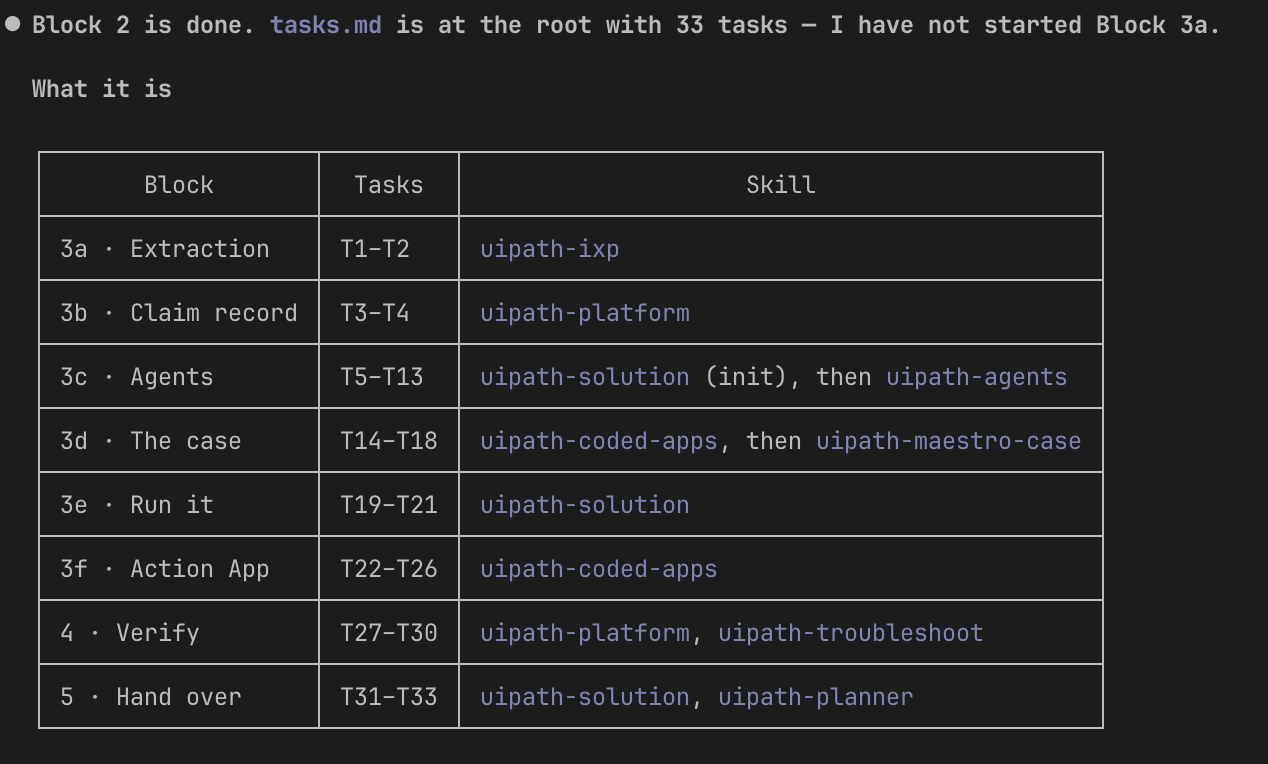
In the shape of the list, the extraction and the entity are leaves (blocked-by: none), every agent waits on the confirmed keys and the solution shell, and each task ends with the check that proves it, so the list runs top to bottom, from the leaves to the case to the screens.
And the agent's own closing report of the block, with the whole plan routed block by block to the skill that builds it. Its last words show it stopped at the boundary rather than rolling into 3a: